Why Does The Bitcoin Mining Difficulty Scale Up? / Lies Damned Lies And Bitcoin Difficulties Dave Hudson - The difficulty is just an arbitrary value, it has no unit.. Bitcoin is designed to adjust its mining difficulty every 2,016 blocks (approximately 14 days), based on the amount of computing power deployed to the network. Cloud mining means a host company owns bitcoin mining hardware and runs it at a professional mining facility. In other words, new btc can be injected into the circulating supply every 10 minutes. How did a bunch of bitcoins, the tokens of a man made invention, end up locked up in circumstances demanding mining? Bitcoin mining equipment prices also follow prices.
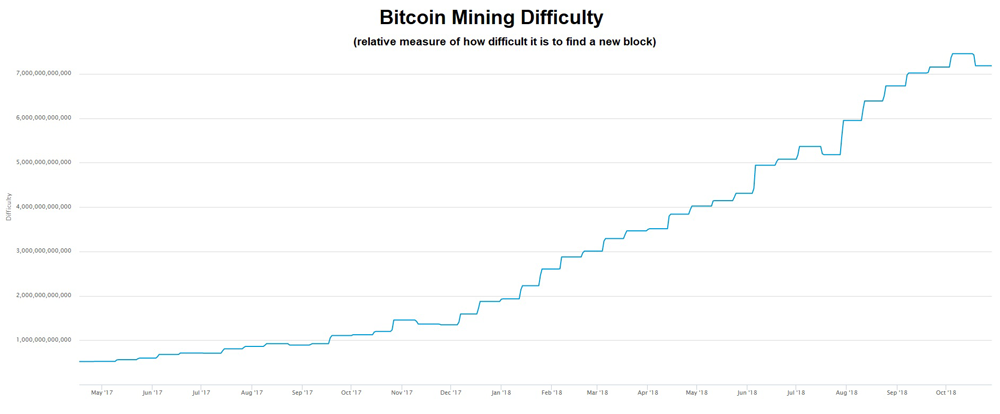
Over the years, mining difficulty increased due to the volume of users joining the market. Bitcoin is designed to adjust its mining difficulty every 2,016 blocks (approximately 14 days), based on the amount of computing power deployed to the network. If the hash rate goes up, so does the computational difficulty and vice versa. The level of bitcoin mining difficulty increases or decreases according to the ease of mining within the protocol. With a difficulty of 16, i can get a share every hour or two on my pc.
Bitcoin Mining Difficulty Hits Record High Amid Miner Revenue Surge Coindesk from static.coindesk.com You pay the company and rent out some of the hardware. When the network's hashing power increases, mining difficulty also increases since a surge in hash rate indicates an influx of miners on the network. If bitcoin mining is a gold rush, then china, where the majority of bitcoin mining pools are located, is california. However, if bitcoin gains scale and captures 15% of the global currency market (assuming all 21 million bitcoins in circulation) the total price per bitcoin would be roughly $514,000. Miners would then have to increase bitcoins price to make a profit. Created from bitcoin , which established a global block difficulty, valid blocks must meet a hash below this target. As bitcoin prices went up in that period, the prices of mining equipment like antminer went up. As the difficulty of mining bitcoin increases, and the price lags behind, it is becoming harder and harder for small miners to make a profit.
As a result, the rig's profit, which was mining the coin before the price took off and after the price took off, has not changed.
Miners would then have to increase bitcoins price to make a profit. If bitcoin mining is a gold rush, then china, where the majority of bitcoin mining pools are located, is california. The bitcoin network has a global block difficulty. Created from bitcoin , which established a global block difficulty, valid blocks must meet a hash below this target. As the difficulty of mining bitcoin increases, and the price lags behind, it is becoming harder and harder for small miners to make a profit. Bitcoin's difficulty is designed to adjust every 2016 blocks — or approximately every two weeks. Over the years, mining difficulty increased due to the volume of users joining the market. Mining difficulty is a measurement unit used in the process of bitcoin mining difficulty indicates how difficult it is to solve a complex cryptographic puzzle This is adjusted on a periodic basis so that the average block solution time is 10 minutes (bitcoin clients recalculate the difficulty every 2016 blocks). If the hash rate goes up, so does the computational difficulty and vice versa. Bitcoin farms that operate at scale use these advantages to maximize their returns. The difficulty can go up or down depending on how much effort people are putting into mining. Bitcoin mining difficulty is the degree of difficulty in finding a given hash below the target during the proof of work.
Bitcoin is designed to adjust its mining difficulty every 2,016 blocks (approximately 14 days), based on the amount of computing power deployed to the network. With a difficulty of 16, i can get a share every hour or two on my pc. Miners would then have to increase bitcoins price to make a profit. You pay the company and rent out some of the hardware. A high difficulty means that it will take more computing power to mine the same number of blocks, making the network more secure against attacks.
What Is Bitcoin Mining And Is It Profitable Ig En from a.c-dn.net Other answers focus on the cost of electricity, the number of hashes or teraflops achieved by a computer cpu or the size of the current bitcoin reward. When people see bitcoin prices go up, they go into a frenzy buying equipment. Bitcoin difficulty is a measure of how many hashes (statistically) must be generated to find a valid solution to solve the next bitcoin block and earn the mining reward. Bitcoin farms that operate at scale use these advantages to maximize their returns. Also, the high electricity cost may. If the hash rate goes up, so does the computational difficulty and vice versa. Cloud mining means a host company owns bitcoin mining hardware and runs it at a professional mining facility. As bitcoin prices went up in that period, the prices of mining equipment like antminer went up.
Based on the amount of hash power you rent, you will earn a share of payments from the cloud mining company for any revenue generated by the hash power you purchased.
Bitcoin mining equipment prices also follow prices. Over the years, mining difficulty increased due to the volume of users joining the market. If the hash rate goes up, so does the computational difficulty and vice versa. As mining times speed up, mining difficulty is increased, bringing the. Bitcoin mining difficulty determines how difficult it will be to mine the next block and this is why it is referred to as the difficulty of bitcoin mining. It is for this reason that bitcoin mining facilities—warehouses filled with computers—have been popping up around the world. One of the most direct ways to own bitcoin is through mining, but that comes with some costs in terms of power and time. The difficulty is a measure of how difficult it is to mine a bitcoin block, or in more technical terms, to find a hash below a given target. Miners would then have to increase bitcoins price to make a profit. As more miners join the network, the difficulty of mining increases. In other words, new btc can be injected into the circulating supply every 10 minutes. Miners may be rewarded with bitcoins, but only if they arrive at the solution before others. Other answers focus on the cost of electricity, the number of hashes or teraflops achieved by a computer cpu or the size of the current bitcoin reward.
Where the aggregate hashrate increases it implies that more people have been joining the bitcoin network as miners. Other answers focus on the cost of electricity, the number of hashes or teraflops achieved by a computer cpu or the size of the current bitcoin reward. It is for this reason that bitcoin mining facilities—warehouses filled with computers—have been popping up around the world. For that reason, bitcoin is designed to evaluate and adjust the difficulty of mining every 2,016 blocks, or roughly every two weeks. Why does mining difficulty go up?
Bitcoin Mining Difficulty Hits Record High Amid Miner Revenue Surge Coindesk from static.coindesk.com Bitcoin difficulty is a measure of how many hashes (statistically) must be generated to find a valid solution to solve the next bitcoin block and earn the mining reward. Created from bitcoin , which established a global block difficulty, valid blocks must meet a hash below this target. For that reason, bitcoin is designed to evaluate and adjust the difficulty of mining every 2,016 blocks, or roughly every two weeks. According to reports, annually, bitcoin mining may consume up to approximately 30t watts. To make sure that this timing doesn't change the bitcoin protocol: This is done to ensure the block. A high difficulty means that it will take more computing power to mine the same number of blocks, making the network more secure against attacks. If the hash rate goes up, so does the computational difficulty and vice versa.
As mining times speed up, mining difficulty is increased, bringing the.
A high difficulty means that it will take more computing power to mine the same number of blocks, making the network more secure against attacks. Why does bitcoin have miners? gold has miners because people want gold and it just so happens, unfortunately, that most gold is deep in the earth. Bitcoin mining difficulty is the degree of difficulty in finding a given hash below the target during the proof of work. You can find the mini. The hash of a block must start with a certain number of zeros. Other answers focus on the cost of electricity, the number of hashes or teraflops achieved by a computer cpu or the size of the current bitcoin reward. When there is more computing power collectively working to mine. When the network's hashing power increases, mining difficulty also increases since a surge in hash rate indicates an influx of miners on the network. One of the most direct ways to own bitcoin is through mining, but that comes with some costs in terms of power and time. How did a bunch of bitcoins, the tokens of a man made invention, end up locked up in circumstances demanding mining? Bitcoin mining equipment prices also follow prices. Bitcoin difficulty vs price by f2pool it all comes down to scale and access to cheaper prices. Bitcoin is designed to adjust its mining difficulty every 2,016 blocks (approximately 14 days), based on the amount of computing power deployed to the network.